
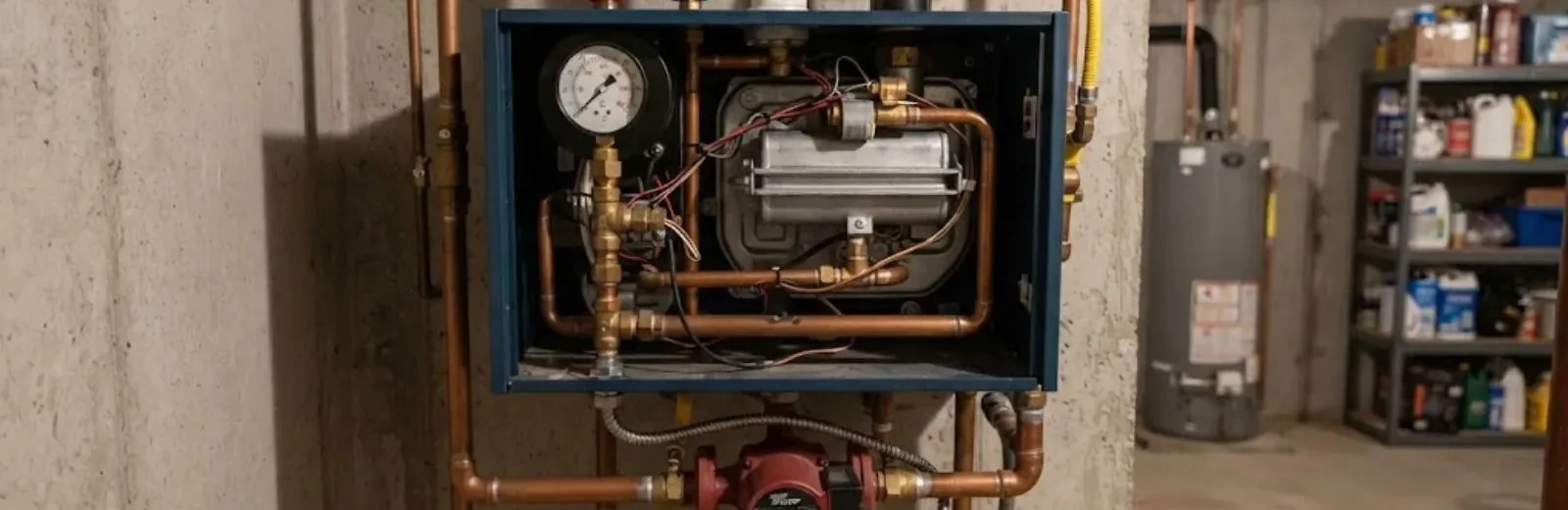
A hot water boiler is a quiet appliance until it stops. In Minnesota, that usually happens on the coldest night of the year. A little attention in the fall, and an understanding of the common failures, makes that night less likely.
How it worksWhat the boiler does
A boiler heats water and sends it through pipes to radiators, baseboard units or in-floor loops. A circulator pump moves the water, an expansion tank absorbs pressure changes and zone valves direct heat to each part of the house. Controls tell the burner when to fire.
Because the system is a closed loop, air and pressure matter. Too much air causes noise and cold spots, and incorrect pressure causes relief valves to open.
SafetyCarbon monoxide and annual checks
According to the Minnesota Department of Health, fuel-burning appliances should be checked every year by a qualified heating contractor. State law requires at least one operational carbon monoxide alarm within 10 feet of every room legally used for sleeping.
If anyone feels dizzy or ill while the boiler runs, leave the building and call the fire department or 911.
Annual serviceWhat a good annual visit includes
Inspect the burner and flue
Look for soot, rust, corrosion and a proper vent path.
Check controls
Test the thermostat, high limit and low water cutoff.
Test the pump and valves
Make sure the circulator spins and zone valves respond.
Check pressure
Verify the system pressure, expansion tank and relief valve.
Look for leaks
Inspect fittings, valves and piping for weeping.
Things you can look at yourself
- Read the pressure gauge. It should sit in the range your installer marked.
- Listen for banging, rushing water or a pump that hums but does not turn.
- Feel radiators for cold spots at the top, which suggest trapped air.
- Look for water at the base of the boiler.
- Keep the area around the boiler clear of storage and dust.
Problems we see most often
| Symptom | Likely cause | Typical fix |
|---|---|---|
| No heat anywhere | Power, control or pump failure | Check the switch, then test the pump and controls |
| Heat in some rooms only | Air in the loop or a stuck zone valve | Bleed air or replace the valve |
| Banging or rushing sounds | Trapped air or low water | Bleed and refill |
| Relief valve drips | High pressure or a failed expansion tank | Test the tank and the valve |
| Water at the base | Leaking fitting or boiler body | Locate the source quickly |
Our boiler repair page explains what we repair and how we decide between repair and replacement.
Rather have a plumber look at it?
Describe boiler maintenance and repair on the 24/7 line and we explain the next step before any work starts.
When replacement makes sense
A boiler with a leaking heat exchanger or a cracked section is usually near the end. Frequent repairs, parts that are no longer available and efficiency concerns all point toward replacement. A good technician tells you what is sound and what is not, and lets you decide.
A Champlin note
Winter nights in Minnesota test any heating system. The American Red Cross advises keeping the thermostat set at a consistent temperature, opening cabinet doors to let warm air reach pipes on cold nights and letting a trickle of water run from a faucet on an exterior wall during extreme cold.
If your boiler fails during a deep freeze, call early. Pipes near exterior walls can freeze within hours, and see burst pipe repair if one does.
What to do if the carbon monoxide alarm sounds
Treat a carbon monoxide alarm as real until proven otherwise. Get everyone outside into fresh air, then call 911 or the fire department from outside. Do not go back in to open windows or silence the alarm. Wait for responders to say the building is safe.
The Minnesota Department of Health lists fuel-burning appliances such as boilers and water heaters among the common sources. Symptoms include headache, dizziness and nausea, and they can be mistaken for the flu. Once the building is cleared, a qualified heating contractor should inspect the appliance before it is used again.
Fall checklistA simple fall checklist for the homeowner
A little preparation in October saves a cold night in January. Walk through the boiler room with a flashlight and look for rust streaks, white mineral crust at fittings and puddles under the unit. Write down the pressure reading so you can compare it later.
Test the carbon monoxide alarms, replace dead batteries and make sure the alarm near each bedroom is within the 10-foot rule that Minnesota law sets. Clear storage away from the boiler so a technician has room to work, and so nothing combustible sits close to the unit.
- Bleed air from radiators or baseboards that run cool at the top.
- Confirm the thermostat holds a steady temperature.
- Check insulation on exposed pipes near exterior walls.
- Book the service visit before the first cold snap, when schedules fill.
Boilers and water heaters
Some homes pair the boiler with an indirect water heater, a tank heated by the boiler. If hot water is the problem and heat is fine, the issue may be the tank or its controls. See water heater repair.
We service boilers across Champlin and in nearby Anoka and Maple Grove. We handle boilers and hydronic piping, and we recommend an HVAC contractor for forced-air furnaces. Call (855) 575-2890 to book a fall service or report a failure.
FAQsBoiler Questions in Champlin
How often should a boiler be serviced?
The Minnesota Department of Health advises annual checks by a qualified heating contractor.
Why does my boiler make noise?
Trapped air, low pressure or a failing pump are common causes.
Do you repair furnaces?
No. We repair boilers and hydronic systems.
What should the pressure gauge read?
Check the range your installer marked. Call if it climbs or drops sharply.
What if my boiler quits on a cold night?
Call the line. Protect pipes on exterior walls as the Red Cross advises.