
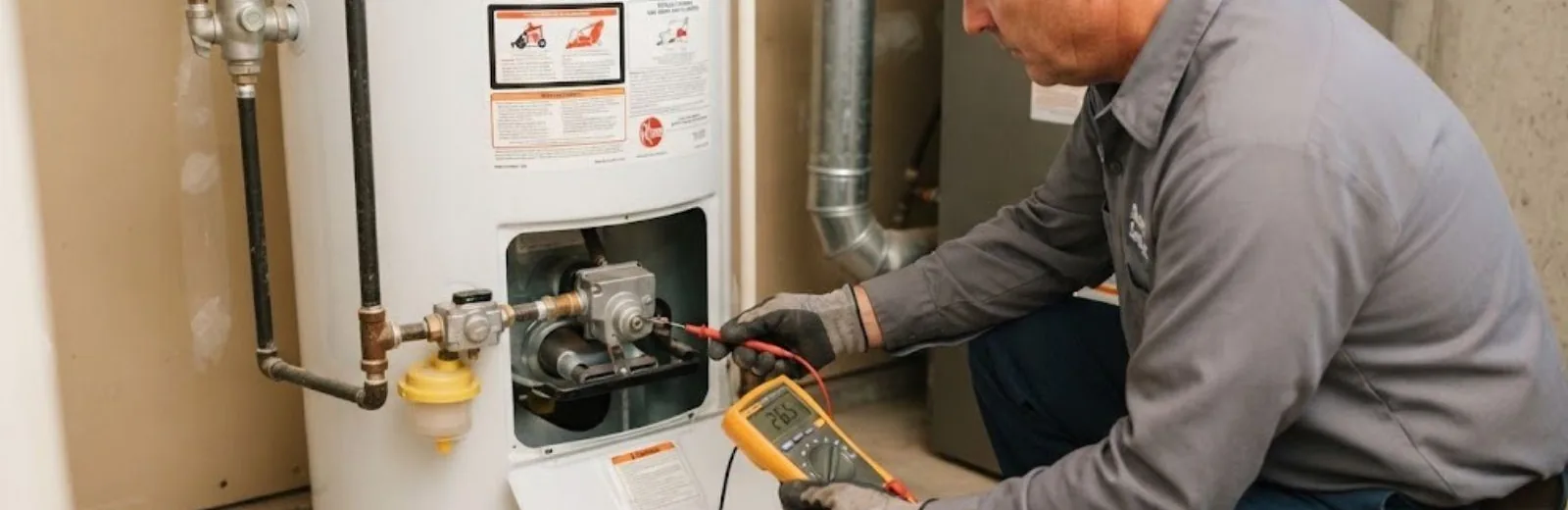
Water on the floor around a tank, or no hot water at all, is an emergency in a Minnesota house, and our line is open 24/7. We book same-day appointments when available and repair first when repair makes sense.
Before help arrives, close the cold water valve on the pipe feeding the top of the tank. Turn off the breaker for an electric unit. For a gas unit, set the control to off only if you do not smell gas. If you smell gas, leave the building and call 911 or the gas utility before you call anyone else.
Urgent situationsWhen a leaking water heater is an emergency
A little condensation on a cold tank is normal. A steady drip, a puddle or water running toward a floor drain is not. Where the water comes from decides what happens next.
Leak from the tank itself
Water seeping from the bottom or side of the tank means the steel has failed. That cannot be repaired, and the answer is replacement.
Leak at a fitting or valve
Drips at the inlet, outlet, drain valve or relief valve are often fixable. A new fitting costs far less than a new heater.
Water at the slab edge
Water that shows up at the edge of a garage slab or a basement wall may be traveling from a heater leak or a line leak. Tracing it is a job for leak detection.
Rust-colored water
Rusty hot water, with clear cold water, points at corrosion inside the tank. It is a warning that a leak may follow.
No hot water: what we check first
Callers with no hot water usually want to know one thing, which is whether the heater can be saved. The answer depends on the fuel and the symptom.
Electric unit
A tripped breaker, a failed heating element or a bad thermostat are the usual causes. Elements and thermostats are routine repairs when the tank is sound.
Gas unit
A pilot that will not stay lit, a worn thermocouple or a dirty burner assembly cause most no-heat calls. The venting and gas supply get checked at the same visit.
Hot water runs out fast
A broken dip tube or sediment on the tank bottom can cut capacity. Flushing and a part swap sometimes restore it.
Water is lukewarm
One failed element in a two-element tank can leave you with warm water that never gets hot.
Gas, electric and heat pump water heater repair
Most Champlin homes heat water with gas or electricity. Gas service in the city comes from CenterPoint Energy, and electric service comes from Anoka Municipal Utilities, Xcel Energy or Connexus Energy depending on your address. Knowing your provider helps if a repair needs a gas supply check or a breaker panel look.
Heat pump, or hybrid, water heaters add a compressor and condensate drain to the mix. They are repairable, but parts and refrigerant-side work are specialized, so describe the make and model when you call.
Repair or replaceRepair or replace: honest trade-offs
Repair makes sense when
- The tank is not leaking.
- The part that failed is an element, thermostat, valve or burner part.
- The heater is still sized right for the household.
- The rating plate shows a manufacture date that is not old.
Replacement makes sense when
- Water is escaping from the tank body.
- Repairs are repeating within months.
- Rust shows in the hot water.
- The unit is too small now, or you want a tankless option.
We tell you which side of that line your heater falls on and put the number in front of you before any work starts. If repair is the honest answer, we repair. When replacement is smarter, the replacement page explains how that job runs.
Safety valvesThe relief valve and the discharge pipe
Every tank water heater has a temperature and pressure relief valve, and Minnesota's plumbing code (Minn. R. 4714.0504) says no shutoff valve may sit between the relief valve and the heater. Discharge piping must not have valves or obstructions, and a relief valve drain may not end in a crawl space (Minn. R. 4714.0608).
One manufacturer's manual says to operate the relief valve by hand at least once a year, with the discharge line clear and the water treated as scalding. If your valve drips regularly, it is reporting a pressure or temperature problem, and it should be diagnosed, not capped.
Champlin waterHard water, scale and your water heater
Champlin's drinking water comes from six city wells, and the city's latest water quality report does not state a hardness value. That means the only way to know what your water does to a heater is to test your own tap or ask the Utilities Department about hardness.
Hardness leaves scale on elements and the tank bottom, which shortens element life and makes tanks rumble as they heat. A flush at the right interval slows that, and a softener solves it for the whole house. Our water softener page covers how to decide.
StandardsStandards behind the repair
According to Minnesota's plumbing code (Minn. R. 4714.0504), the temperature and pressure relief valve must have a capacity at least equal to the heater's input rating. A repair visit includes a look at that valve and its discharge pipe.
PriceWhat water heater repair costs and what changes the price
Homeowner insurance often covers sudden water damage but not a leak that has dripped for months, and it rarely pays for the heater itself. Take photos of the leak and the rating plate, and ask your agent before you file.
FAQsQuestions About Water Heater Repair
Do you handle water heater emergencies at night or on weekends in Champlin?
Yes. The line is open 24/7, including weekends and holidays, and we book same-day appointments when available. Call (855) 575-2890, tell us the fuel type and the symptom, and you hear the price before work starts.
Is a leaking water heater always a failed tank?
No. Leaks at the inlet, outlet, drain valve or relief valve are often repairable. A leak from the tank body is not, and that means replacement.
Why does my water heater make popping or rumbling sounds?
Sediment on the tank bottom traps water that boils and pops. Flushing can help, and heavy buildup is a sign the tank is aging.
My relief valve is dripping. Is that dangerous?
It can be. The valve opens when pressure or temperature is too high, so a drip means something is off. Do not plug the valve. Have it diagnosed, and treat the discharge water as scalding.
How do I know whether my water heater is gas or electric?
A gas heater has a vent pipe on top and a gas line with a control at the bottom. An electric heater has heavy wiring going into a cover plate on the side or top.