
When the main sewer line blocks, every fixture in the house is affected, and the lowest drain is the first to show it. Our 24/7 line takes sewer cleaning calls at any hour, and we book same-day appointments when available.
Stop using water now. Do not run the washer, dishwasher or shower, and do not flush. Keep people and pets out of any area with sewage on the floor, and keep electrical devices out of standing water. Take photos before anything is cleaned or moved.
Urgent situationsSewage backup: what is happening and what to do
A backup means wastewater has nowhere to go. Water that rises in a basement floor drain, a toilet that fills when you run the washer, or a tub that gurgles during a flush are the usual signs.
Lowest drain overflows first
Gravity pushes backed-up water to the lowest opening, usually a basement floor drain or laundry standpipe.
Multiple fixtures react
If the toilet, tub and floor drain all misbehave, the blockage is in the main, not a branch.
Gurgling and odor
Air displaced by a blockage rises through traps and brings sewer smell with it.
Backup after rain
A backup that shows up during heavy rain can point to the city main or to groundwater getting into a leaky lateral.
City main or your own line
The City of Champlin Utilities Department maintains the public sanitary sewer, and the Metropolitan Council treats the wastewater at its Metro plant. The line from your house to the connection is yours. If a neighbor has the same backup, call the city Utilities Department as well as us, because a city main blockage affects several homes.
We can tell a lot from a cleanout. If water stands in the cleanout, the blockage is downstream of it. If the cleanout is dry and fixtures still back up, the blockage is upstream in the house line.
Cleaning methodsHow a main sewer line gets cleaned
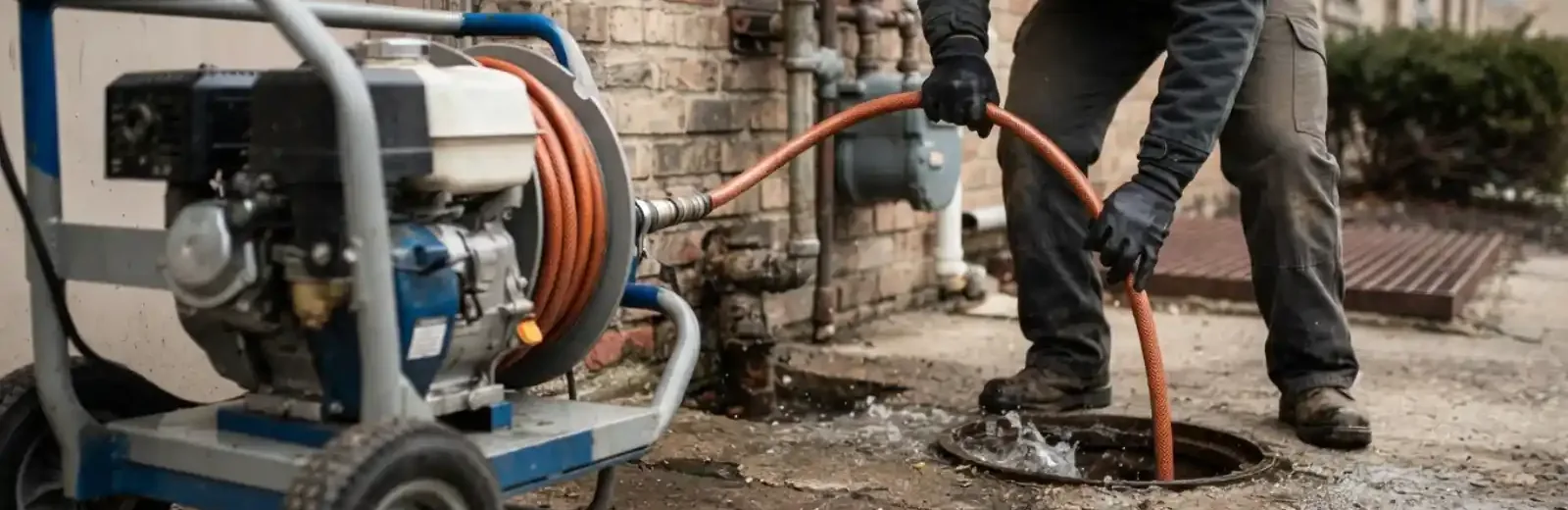
Most main lines are cleared with a drum cable machine run from a cleanout. A cutting head handles roots, and a retrieving head can pull out a wad of wipes or a toy. When cable work only opens a hole, hydro jetting scrubs the wall.
Minnesota's plumbing code (Minn. R. 4714.0707) calls for a cleanout at the upper end of each horizontal drainage pipe, and those access points are what make cleaning possible.
After the line is open, a camera inspection tells you whether cleaning is enough. A line that is sagging, cracked or invaded by roots will clog again, and we would rather you know that than pay for the same visit twice.
What to avoidWhat causes main line blockages
- Wipes sold as flushable, which do not break down like paper.
- Grease poured down kitchen drains, which hardens in cooler pipe.
- Tree and shrub roots that enter at joints and cracks.
- Collapsed or offset pipe where sections no longer line up.
- Too much paper at once, or a foreign object such as a toy.
Septic systems and private lines
Some properties near Champlin are on septic systems rather than city sewer, especially in Dayton, where the city's complete plan counts roughly 885 septic systems. A backup there may involve the tank, the drain field or the line to the tank. We explain which part is involved and whether cleaning, pumping or repair is the next step.
PriceWhat sewer line cleaning costs and what changes the price
Water backup is often excluded from standard homeowner policies unless an endorsement was added. Call your agent before you file and ask what documentation they want.
We take sewer cleaning calls in Champlin 55316 and nearby ZIP codes, including 55303 in Anoka, 55369 in Osseo, 55430 in Brooklyn Center and 55327 in Dayton.
FAQsQuestions About Sewer Line Cleaning
Do you handle sewer backup emergencies at night or on weekends in Champlin?
Yes. The line is open 24/7. We book same-day appointments when available and tell you the price before work starts.
Should I call the city or a plumber for a sewer backup?
Call us for your own line. If neighbors have the same problem, also call the City of Champlin Utilities Department, since a city main may be involved.
Can I use chemicals to clear a main line?
We advise against it. Chemicals do not clear a full main line, and they become a hazard once a plumber opens it.
How do I know if the problem is the main line?
If more than one fixture backs up, or the lowest drain overflows, the main is the likely location.
Will my line clog again after cleaning?
It may if roots, a sag or a crack caused the clog. A camera inspection after cleaning shows what is behind it.