
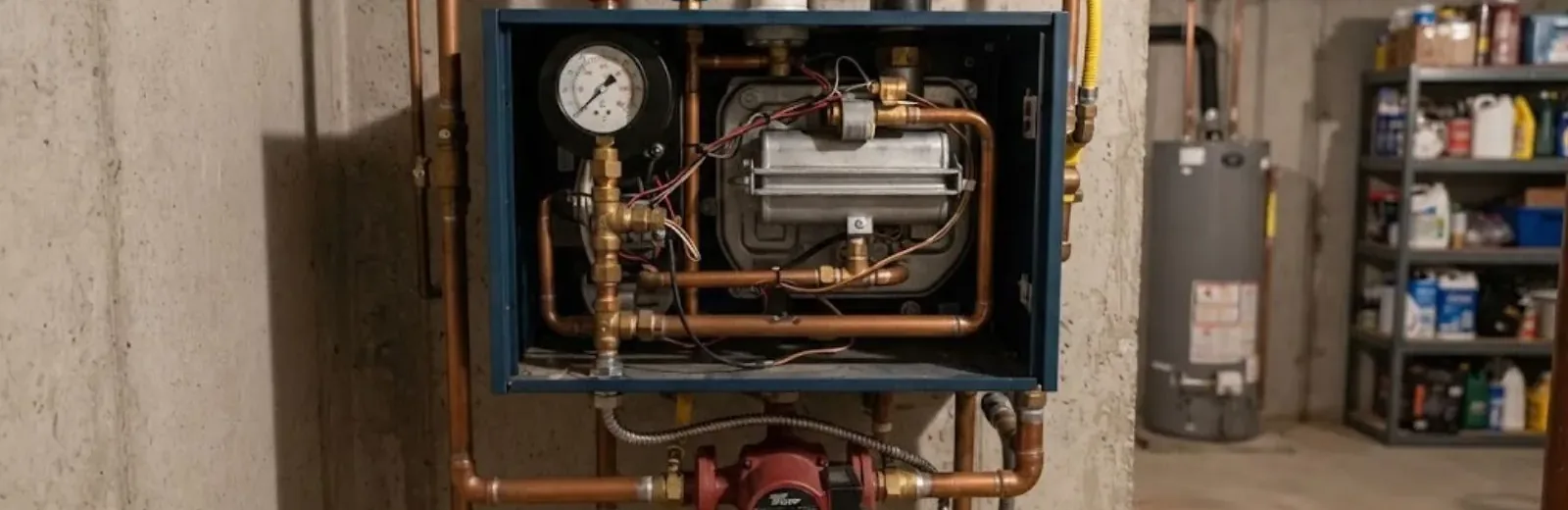
A boiler heats water that travels through radiators, baseboard or in-floor loops, and it is one of the quieter parts of a house until it stops. Our line is open 24/7, and we book same-day appointments when available. A boiler that fails on a cold night is a priority call, even though the work itself is planned and methodical.
Common problemsCommon boiler problems and what they mean
No heat at all
A tripped switch, a failed circulator pump, a tripped limit or a control fault can stop the whole system. A power check comes first.
Heat in some rooms only
Air in the loop or a stuck zone valve can shut one zone off. Bleeding air and replacing a zone valve are routine repairs.
Banging or rushing sounds
Trapped air, low water or a failing circulator can produce noise that a technician can trace.
Water at the boiler
A leak at a fitting, the relief valve or a weeping joint should be addressed quickly. A pressure relief valve that discharges is a warning.
Carbon monoxide and annual checks
The Minnesota Department of Health says you should have fuel-burning appliances, such as a furnace, checked by a qualified heating contractor every year. State law requires at least one operational carbon monoxide alarm within 10 feet of every room legally used for sleeping.
If anyone has headaches, dizziness or nausea and the boiler is running, leave the building and call the fire department or 911. Do not wait for a repair visit.
What we repairWhat boiler service and repair covers
- Circulator pumps and zone valves that stop moving water or heat.
- Expansion tanks, pressure gauges and relief valves.
- Air elimination and bleeding of baseboard and radiator loops.
- Leaking fittings, valves and supply and return piping.
- Controls, thermostats and aquastats on hydronic systems.
We are plumbers. If the problem is a forced-air furnace or air conditioning, you need an HVAC contractor, and we will say so. Boilers in commercial buildings may have separate inspection requirements, and we tell you when a job needs a specialist.
Planned serviceAnnual maintenance: what it should include
Inspect
Look at the burner, venting, flue and visible piping for wear and leaks.
Test controls
Check the thermostat, limits, pump and zone valves for proper response.
Check pressure
Verify system pressure, expansion tank and the relief valve.
Document
Note findings so next year's visit starts from the record.
Repair or replace a boiler
Repair fits when
- The boiler has been reliable.
- A single part failed.
- The heat exchanger is sound.
- Parts are available.
Replacement fits when
- The heat exchanger is leaking or cracked.
- Repairs keep returning.
- Parts are no longer available.
- Efficiency or safety is a concern.
Tied to boiler work, a water heater tied to the boiler or a tank near it should be examined at the same time. See water heater repair if hot water is the problem and heat is fine.
StandardsWhat state guidance says
According to the Minnesota Department of Health, fuel-burning appliances such as boilers should be inspected every year by a qualified heating contractor, and every home should have an operational carbon monoxide alarm within 10 feet of each bedroom. We follow that guidance on every boiler visit.
PriceWhat boiler repair costs and what changes the price
We take boiler calls across 55316 in Champlin and nearby ZIP codes, including 55303 in Anoka, 55369 in Osseo and 55327 in Dayton. Our plumbing installation page covers new boiler piping and hydronic additions.
FAQsQuestions About Boiler Repair
Can you repair a boiler on the same day?
We book same-day appointments when available. Parts availability can change the timeline, and we tell you when we call.
How often should a boiler be serviced?
The Minnesota Department of Health advises annual checks for fuel-burning appliances by a qualified heating contractor.
Why is my boiler making noise?
Air in the loop, low pressure or a failing circulator are common causes. Call if the noise is new or loud.
Do you repair furnaces?
No. We repair boilers and hydronic piping. For forced-air furnaces, an HVAC contractor is the right choice.
What if I smell gas?
Leave the building and call 911 or the gas utility before you call anyone else.