
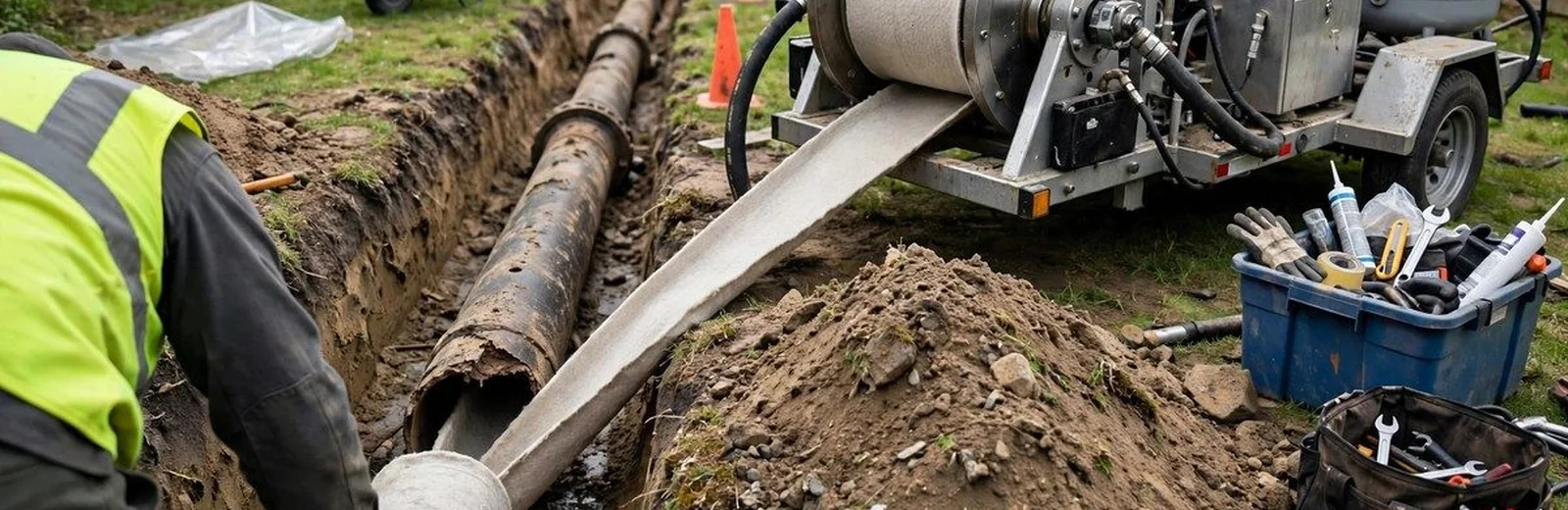
Epoxy pipe lining, also called cured-in-place pipe, has a simple idea. A resin-soaked liner is pulled or inverted into an old pipe, inflated and cured so it forms a new pipe inside the old one. It can repair cracks and leaking joints without trenching across a yard.
People ask what it costs, and the answer depends more on the pipe than on the method. This guide explains the pieces of the price.
The methodHow lining works and the standard behind it
ASTM F1216 is the standard practice for rehabilitating existing pipelines with a resin-saturated tube that is inverted and cured. Contractors follow it, and it describes the process rather than guaranteeing an outcome. We do not claim any drinking water certification for sewer lining, since this is drain pipe work.
Lining starts with cleaning. The old pipe has to be cleared of roots, scale and debris so the liner can bond. A camera run before and after confirms the result.
Cost factorsWhat changes the price
| Factor | Why it matters |
|---|---|
| Length of pipe | More pipe means more liner and more labor |
| Diameter | Larger pipe needs more material |
| Cleaning required | Heavy roots or scale add work before lining |
| Number of bends and connections | Complex layouts are harder to line |
| Access points | A good cleanout makes the job simpler |
| Condition of the host pipe | A collapsed or crushed pipe cannot be lined |
Lining is often compared with digging. Digging costs more in restoration, because lawns, driveways and landscaping are disturbed. Lining costs more in specialized equipment and materials.
For the right pipe, the total may favor lining. For the wrong pipe, lining is a waste.
When it fitsPipes that are good candidates
Lining fits when
- The pipe has cracks or leaking joints.
- Roots enter at the joints.
- The pipe is otherwise round and intact.
- Digging would disturb a driveway or tree.
Lining does not fit when
- The pipe has collapsed or is badly offset.
- A deep sag holds water.
- The line has a break that needs excavation.
- The pipe is too misshapen to line.
A camera inspection decides which side you are on. See sewer camera inspection for what the footage shows. If the pipe cannot be lined, sewer line repair covers spot repair and replacement.
Beyond sewerLining water supply pipe is a different matter
Epoxy coatings for drinking water pipes are a separate topic. They must be listed for potable use, and homeowners should ask for the product data sheet and proof of listing. We do not recommend accepting a general statement that a coating is safe. When supply pipe is failing throughout a house, repiping is often the cleaner answer.
Rather have a plumber look at it?
Describe epoxy pipe lining cost on the 24/7 line and we explain the next step before any work starts.
Questions to ask before you agree
- Has the pipe been cleaned and filmed before lining?
- What does the warranty cover and for how long?
- How are connections and lateral lines handled?
- Will you provide footage after the liner cures?
- What happens if the camera finds a collapse?
Why local conditions matter
The Minnesota DNR describes the Anoka Sand Plain as level to gently rolling with sandy terraces. Sandy ground shifts when trenched, and low ground near the river can fill a trench with groundwater. Those are reasons trenchless options get considered.
Call Gopher State One Call at 811 before any digging so buried lines are marked.
How to compare two lining quotes
Two quotes for the same pipe can look very different, and the difference is often in what is included. One may include cleaning and a camera record before and after, while the other leaves them out. One may line only the main run, while the other includes the connection at the street and the lateral lines.
Ask each contractor to list the footage, the diameter, the number of access points and the warranty terms in writing. If the number is far below the rest, find out what is missing. Cheap lining over a dirty pipe fails early, and the failure is expensive.
Also ask who owns the work after the liner cures. A trustworthy installer provides the final footage, explains any spots that look imperfect and tells you how to spot problems later. According to ASTM F1216, the liner is cured in place after installation, so the final camera run is the only way to see whether it bonded properly.
AlternativesWhen another method is the better choice
Pipe bursting pulls a new pipe through the old path while breaking the old one apart, and it suits pipe that is too damaged to line but can still follow its old route. Spot repair suits a single failure. Full excavation suits a collapsed or deeply sagging pipe, where no liner would hold.
The camera and the locator decide among these, and a plumber who recommends only one method for every pipe is selling a product and not a solution. Our sewer line repair page compares all of them.
TownsThe same logic applies across our area
Homes in Brooklyn Park built in the 1970s and 1980s and older homes in Anoka often have the kind of aging joints that lining can address. A camera tells you which pipe you have. Call (855) 575-2890 and we explain the options and the price before work starts.
FAQsPipe Lining Questions in Champlin
How long does a liner last?
It depends on installation and the host pipe. Ask for the manufacturer's data and the installer's experience.
Can lining fix a collapsed pipe?
No. A collapse or severe offset needs excavation.
Does lining reduce pipe diameter?
Slightly. The wall is thin, though the interior is smooth.
Do I call 811 before lining?
Digging access pits would need it. Call 811 before any excavation.
Is lining approved for drinking water?
That requires a product listed for potable use. Sewer lining is for drain pipe.