
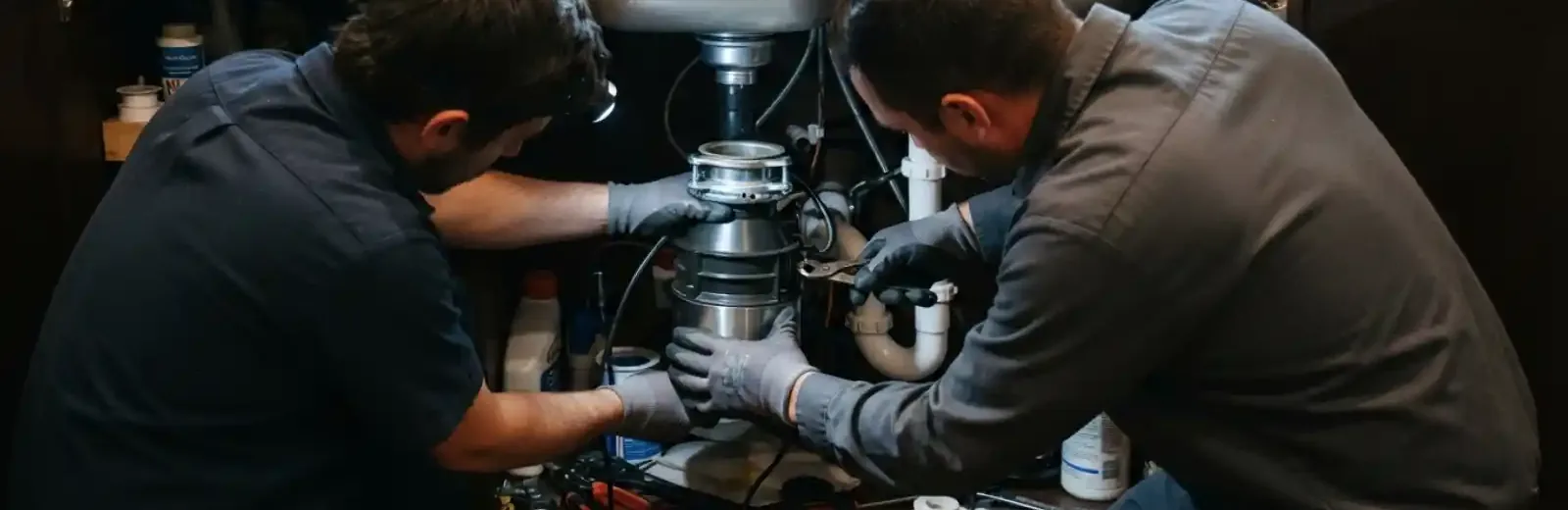
Installing a garbage disposal is a job that many handy homeowners attempt. It is also a job where small mistakes, like a bad gasket or a missed knockout plug, cause leaks and flooding that appear days later. This guide explains the steps in order so you can decide whether to do it yourself.
Before you startPlan the install
Turn off power at the breaker, not just at the wall switch. Check that you have an outlet under the sink or a plan for hardwiring, and that a new unit fits the space. Disposals vary in height, and the trap arm must line up with the discharge.
If the sink has a dishwasher, note where the dishwasher drain hose connects. Many new disposals have a knockout plug in the dishwasher inlet that must be removed before the hose is attached.
MountingMount the new disposal
Remove the old unit
Disconnect the trap, loosen the mounting ring and lower the old disposal.
Clean the flange
Remove old putty and set the sink flange with new putty or a gasket.
Attach the mounting assembly
Secure the ring and snap ring so the flange is tight.
Hang the unit
Lift the disposal onto the mount and rotate it until it locks.
Drain, dishwasher and power
Attach the discharge elbow with its gasket to the disposal and align it with the trap. If a dishwasher is present, remove the knockout plug from the inlet, then attach the hose with a clamp. Forgetting the plug is the most common reason a new disposal causes a dishwasher to back up.
Wire the unit to its cord or hardwire it according to the manufacturer's instructions and local code. If you are not comfortable working with household wiring, bring in an electrician.
TestTest for leaks
Fill the sink with water, release it and check every joint with a dry paper towel. Run the disposal with cold water. The manufacturer InSinkErator advises running cold water during use and for about 15 seconds afterward to flush waste through the drain. If the dishwasher is connected, run a short cycle and watch the connection.
| Mistake | Result | Prevention |
|---|---|---|
| Knockout plug left in | Dishwasher backs up | Remove the plug before connecting the hose |
| Loose mounting ring | Leak at the sink flange | Tighten evenly and test |
| Wrong trap alignment | Strain and leaks at the elbow | Dry fit before tightening |
| Switch left on during work | Injury risk | Cut power at the breaker |
| Grease down the drain | Clogs | Avoid grease and oils |
Rather have a plumber look at it?
Describe how to plumb a garbage disposal on the 24/7 line and we explain the next step before any work starts.
Habits that keep a disposal working
InSinkErator's guidance includes avoiding grease, fats and oils. Fibrous foods, large quantities of starchy peels and bones are common causes of jams. Using a steady stream of cold water helps move waste through the line.
If the unit jams, turn off the power and never reach inside. A plumber can free it from below. See garbage disposal repair for details.
When the drain is the problemA slow sink after install
A new disposal does not fix a clogged drain line. If the sink drains slowly after the install, the trap or the line beyond it may be restricted, and drain cleaning clears it. Grease that has built up over time may call for hydro jetting.
Local plumbing note
Champlin's water comes from six city wells, and the city's report does not give a hardness value. Mineral scale can build up on faucet aerators and in sink drains, and testing your tap tells you whether it is worth treating.
Choosing a disposal that fits
Disposals come in a range of motor sizes, and the larger ones handle more but cost more and take more room under the sink. Check the height, since a tall unit can collide with a trap arm or a shelf. Think about how you cook. A household that rarely puts food in the drain does not need the biggest motor.
Look for a continuous feed model with a sound-insulated housing if noise matters. Batch feed models run only when a stopper is in place, which some households prefer for safety.
Safety firstSafety guidelines while you work
Never put a hand inside a disposal, and never rely on a wall switch alone when working on one. According to InSinkErator's installation guidance, power should be disconnected at the breaker before the old unit is removed. Keep the new unit's power cord unplugged until the last step.
Wear gloves when handling the old unit, since the flywheel and the housing have sharp edges. Dispose of the old disposal at a recycling facility if one accepts it.
When to callWhen to hire it out
Hire a plumber when the drain does not line up, when the old plumbing is corroded, when you do not have an outlet and when you want a warranty on the labor. We install disposals across Champlin, Maple Grove and Coon Rapids. Call (855) 575-2890 and tell us the unit you have chosen.
FAQsDisposal Questions in Champlin
Do I need an electrician to install a disposal?
Only if you need new wiring or a new outlet. A plumber can handle the plumbing side.
Why does my dishwasher back up after installing a disposal?
The knockout plug in the dishwasher inlet may still be in place.
Can I put grease down the disposal?
No. InSinkErator advises avoiding grease, fats and oils.
How long should I run water after using it?
About 15 seconds, according to InSinkErator guidance.
Is my Champlin water hard?
The city's report gives no hardness value. Test your tap.