
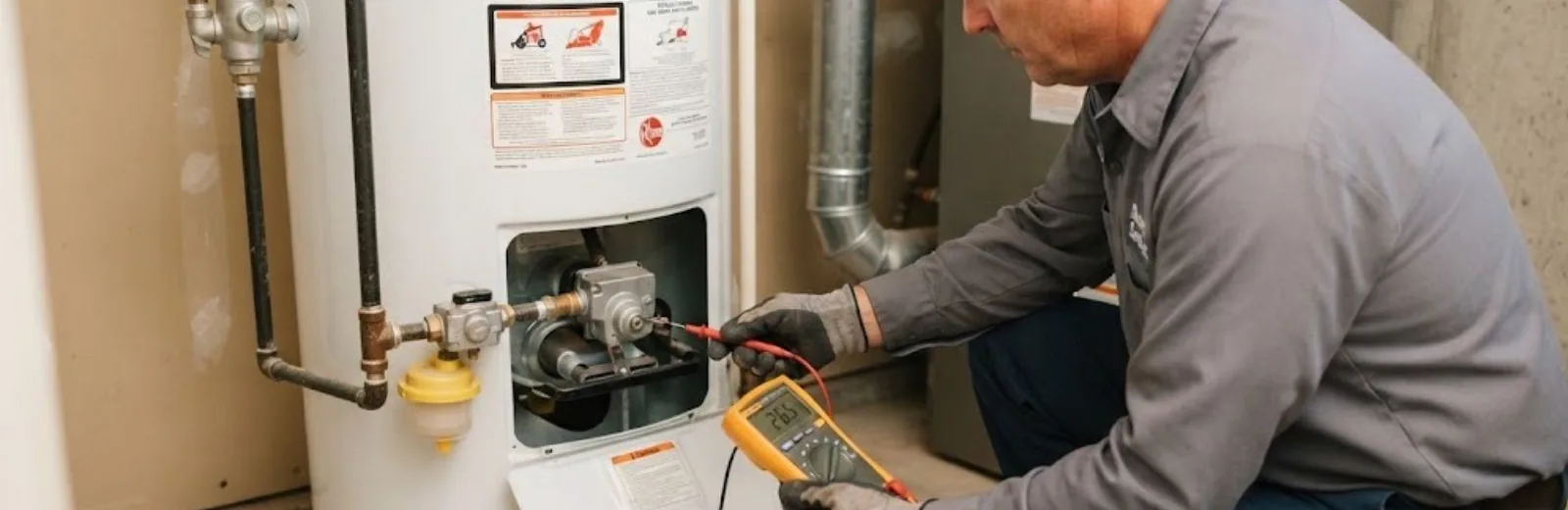
Every water heater has a temperature and pressure relief valve, usually called the T&P valve. It opens if the tank gets too hot or the pressure climbs too high, and it keeps the tank from becoming a hazard. A valve that drips is giving you information, and what it says depends on the cause.
This guide explains the causes, what repair involves and what changes the price. We do not publish a single number because the right fix varies.
Why it dripsCommon reasons for a leaking relief valve
| Cause | What is happening | Typical fix |
|---|---|---|
| High water pressure | House pressure is above what the tank should see | Test pressure, adjust or replace the regulator |
| Thermal expansion | Heated water expands in a closed system | Install or replace an expansion tank |
| Overheating | A thermostat or element is stuck on | Repair the control and test |
| A worn valve seat | Mineral buildup keeps the valve from sealing | Replace the valve |
| A failing tank | The tank itself is at the end of its life | Discuss replacement |
A drip can be harmless in a minor case and a warning in a serious one. Do not ignore a steady stream or a hissing sound.
What to doWhat to do and what never to do with the valve
Do not plug or cap a relief valve, and do not shut it off. According to Minnesota's plumbing code (Minn. R. 4714.0504), the valve's capacity must be at least the heater's input rating, and that no shutoff valve may sit between the relief valve and the heater.
The discharge pipe may not have valves or obstructions, and it may not end in a crawl space (Minn. R. 4714.0608).
If hot water is pouring from the valve and the tank feels extremely hot, shut off the gas or electric supply to the heater and keep people away. If you smell gas, leave and call 911.
What repair involvesA typical service visit
Diagnose
Check the house pressure, the tank temperature and the valve's condition.
Find the cause
Test the regulator, the expansion tank and the thermostat.
Replace the valve
Drain part of the tank, remove the old valve and fit a new one.
Fix the cause
Correct the pressure, thermal expansion or control that made it open.
Test
Lift the lever, confirm discharge and check for leaks.
Replacing the valve alone, when high pressure or expansion is the cause, only treats the symptom. The new valve will drip again.
Cost factorsWhat changes the price
Our water heater repair page explains how we decide between repair and replacement. If the tank is the problem, see water heater replacement.
Rather have a plumber look at it?
Describe pressure relief valve repair cost on the 24/7 line and we explain the next step before any work starts.
Age and corrosion
A tank near the end of its life may leak from the relief valve because mineral deposits and corrosion affect the fittings. If the heater is old, putting money into a valve may not make sense. A technician looks at the tank first and tells you what is sound.
A Champlin note
Champlin's water comes from six city wells, and the city's report gives no hardness value. Hard water leaves scale on valve seats and heating elements, and a flush or a softener can extend equipment life. Test your tap to learn more.
How to test a relief valve safely
Manufacturers advise testing the valve once a year. Place a bucket under the discharge pipe, lift the lever briefly and let it snap back. A burst of hot water should come out and then stop. If water keeps flowing, or nothing comes out, the valve needs replacement.
Hot water can scald. Stand to the side, keep children away and wear gloves. If the valve is stuck, do not force it. Call a plumber instead.
Warning signsSigns the tank is the real problem
- Rusty water coming from hot taps only.
- A rumbling sound from sediment in the tank.
- Moisture or rust at the tank seams or fittings.
- A tank older than the manufacturer's expected life.
Service across our area
We repair relief valves in Champlin and nearby Coon Rapids and Brooklyn Park. Call (855) 575-2890 and describe what the valve is doing. We explain the likely cause and give you the price before work starts.
FAQsRelief Valve Questions in Champlin
Is a dripping relief valve dangerous?
It can be a warning. A steady stream, hissing or a very hot tank needs prompt attention.
Can I cap the valve?
No. It is a safety device. Never cap or plug it.
Why does the new valve drip too?
The cause may be pressure or thermal expansion, not the valve.
Where should the discharge pipe end?
Not in a crawl space, and the pipe may have no valves or obstructions.
Does hard water affect the valve?
Scale can keep it from sealing. Test your tap, since the city gives no hardness value.